BPC-157 GI and Gut Health
544 Papers Screened
A 2025 systematic review screened 544 BPC-157 articles for orthopaedic applications. Only 1 clinical study met inclusion criteria. Three pilot studies totaling roughly 30 human subjects represent the entire published human evidence base for this peptide.
Vasireddi et al., HSS Journal, 2025
~30 Total Human Subjects
across all published human data
80%+ From One Lab
Sikiric group, University of Zagreb
FDA Category 2
cannot be legally compounded since 2023
Vasireddi et al., HSS Journal, 2025
If you only read one thing
BPC-157 has tons of animal research showing it helps with healing — gut, tendons, and more. But almost no one has actually tested it in people. Only about 30 humans have ever been studied, all by one doctor, with no control groups. The FDA made it illegal for pharmacies to compound in 2023. The animal science is real, but calling it 'proven' is a stretch when 99.7% of the research is in rats.
BPC-157 is one of the most discussed peptides on the internet. It has Reddit communities with tens of thousands of members, dedicated podcast segments, and a following that includes professional athletes, biohackers, and parents injecting their children for sports injuries. Search "BPC-157 research" and you will find 544 published papers. What you will not find is anything close to the evidence base those numbers suggest.
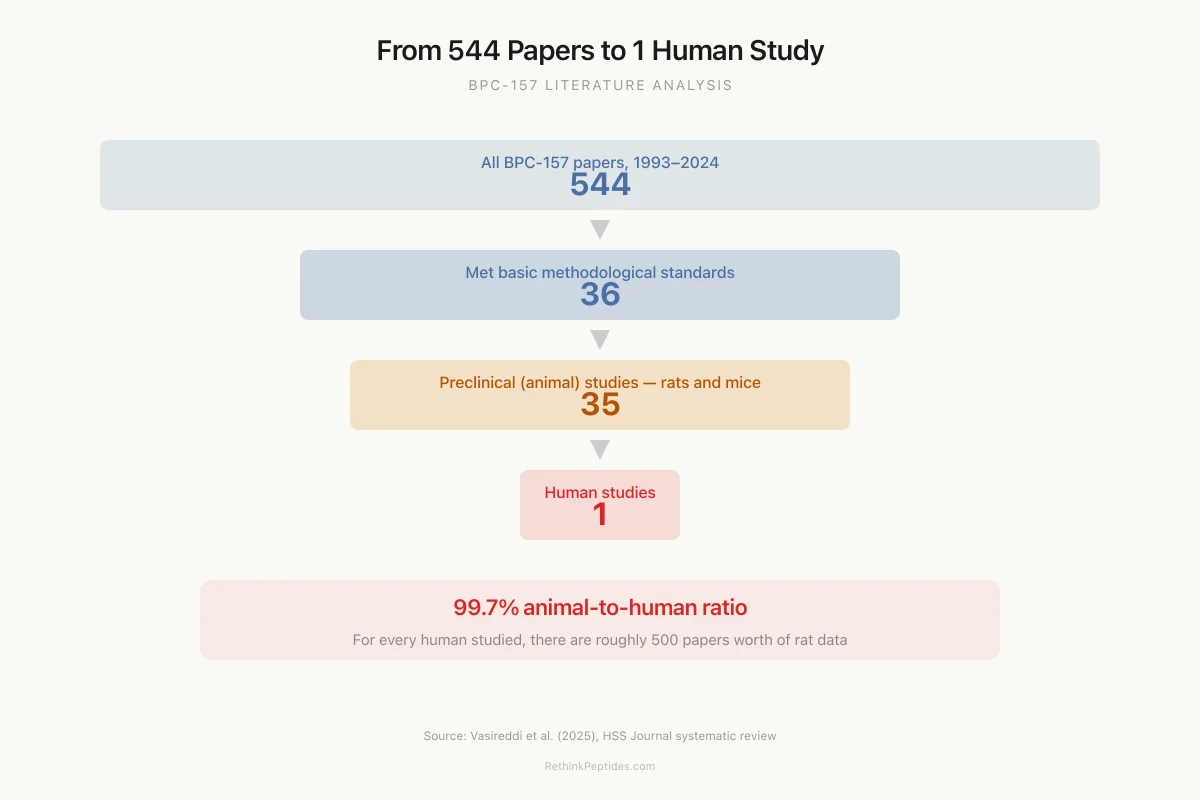
A 2025 systematic review in the HSS Journal screened all 544 of those articles for orthopaedic applications.[1] After applying standard inclusion criteria, 36 studies remained. Thirty-five were animal studies. One was a clinical study in humans. That ratio, 35 to 1, is the real BPC-157 story.
Key Takeaways
- Out of 544 BPC-157 studies everyone cites, only one was actually done in humans — one.
- Fewer than 30 people have ever been studied on BPC-157, all by one doctor with no control group.
- The hype says "proven to heal" — actual human evidence is three tiny pilot studies and zero controlled trials.
- Animal research is real and consistent, but roughly 9 in 10 animal drugs fail once tested in real people.
- Over 80% of BPC-157 research comes from one lab whose leader also owns the company holding the patents.
- A real pharma trial for gut disease ran in the early 2000s, then the results quietly vanished.
- Since 2023 it's illegal for U.S. pharmacies to compound BPC-157, so anything sold online is unregulated research chemical.
Fact Check
The internet consensus vs. the published evidence
The claim
“BPC-157 is well-researched and proven to heal injuries, gut issues, and more — there are hundreds of studies”
Peptide forums, biohacking podcasts, supplement marketing, Reddit communities with 50,000+ members
What research shows
OverstatedOf 544 screened papers, only 1 clinical study met basic methodological standards. Three uncontrolled pilot studies totaling ~30 humans represent the entire human evidence base. No randomized controlled trial has ever been conducted.
The animal research is genuinely extensive and consistently positive. Something real is happening in those studies. But 'hundreds of studies' and 'proven in humans' are very different claims, and BPC-157 only has the first.
Vasireddi et al. (2025), HSS Journal systematic review of 544 articles
What BPC-157 Actually Is
BPC-157 is a synthetic peptide. It is 15 amino acids long, derived from a larger protein called BPC (Body Protection Compound) that is found in human gastric juice. The key word is "derived." BPC-157 does not exist in this exact 15-amino-acid sequence in the human body. It is a fragment, isolated and synthesized in a lab.
The peptide was first characterized in the early 1990s at the University of Zagreb in Croatia. Researchers there identified it as unusually stable in stomach acid, which is rare for peptides. Most peptides break down within minutes in the acidic environment of the stomach. BPC-157 does not.
In animal studies, BPC-157 appears to work through several pathways. A 2018 review by Sikiric described its effects on the VEGF pathway, which drives the formation of new blood vessels (angiogenesis), and on the nitric oxide system, which regulates blood flow and inflammation.[7] A 2014 study by Chang and colleagues in Taiwan found that BPC-157 increased growth hormone receptor expression in tendon fibroblasts, cells that build and repair tendons.[9] That Taiwanese study is notable because it is one of the few BPC-157 mechanism studies conducted outside the originating lab in Zagreb. For more on oral BPC-157 and its gastric stability, that topic gets its own deep dive.
The 544-Paper Illusion
Literature Analysis
From 544 Papers to 1 Human Study
That is a 99.7% animal-to-human ratio. For every human who has been studied, there are roughly 500 papers worth of rat data.
Source: Vasireddi et al. (2025), HSS Journal
 View as image ↗
The number 544 sounds impressive. It is meant to. But what does that number actually contain?
Vasireddi and colleagues at the Hospital for Special Surgery published the most rigorous accounting of BPC-157 literature to date in 2025.[1] They screened 544 articles published between 1993 and 2024. After removing duplicates, reviews, editorials, and studies that did not meet basic methodological standards, 36 remained. Of those 36, 35 were preclinical studies conducted in animals. One was a clinical study.
Vasireddi et al. (2025) · HSS Journal
- Population
- All published BPC-157 literature (544 articles, 1993-2024)
- Intervention
- Systematic screening with standard inclusion criteria for orthopaedic applications
- Comparator
- N/A — this was a literature review, not a treatment comparison
- Finding
- Of 544 articles screened, 36 met inclusion criteria. 35 were animal studies. 1 was a clinical study in humans.
preliminary Extensive preclinical data, near-total absence of human evidence
Vasireddi et al. (2025), HSS Journal
That is a 99.7% animal-to-human ratio.
A separate 2025 narrative review by McGuire and colleagues asked a blunter question in its title: "Regeneration or Risk?"[2] Their conclusion: the preclinical evidence is consistently positive, but the absence of human data makes it impossible to generate evidence-based practice guidelines. The gap between what BPC-157 does in a rat and what it does in a human is not a small gap. In pharmaceutical development, roughly 90% of drugs that work in animals fail in human trials. BPC-157 has not yet reached the point where it can fail, because the trials have not been conducted.
Every Human Study, Counted
Human evidence
The complete BPC-157 human evidence base
~30
total human subjects
across all published studies
3
pilot studies
none with control groups
1
investigator
Edwin Lee, all 3 studies
1
journal
Alternative Therapies in Health and Medicine
For comparison, semaglutide (Ozempic) went through Phase III trials with thousands of patients across multiple countries before approval.
Lee (2021, 2024, 2025); Vasireddi et al. (2025) systematic review
Three studies. One author. One journal. Roughly 30 total subjects.
Human Evidence Timeline
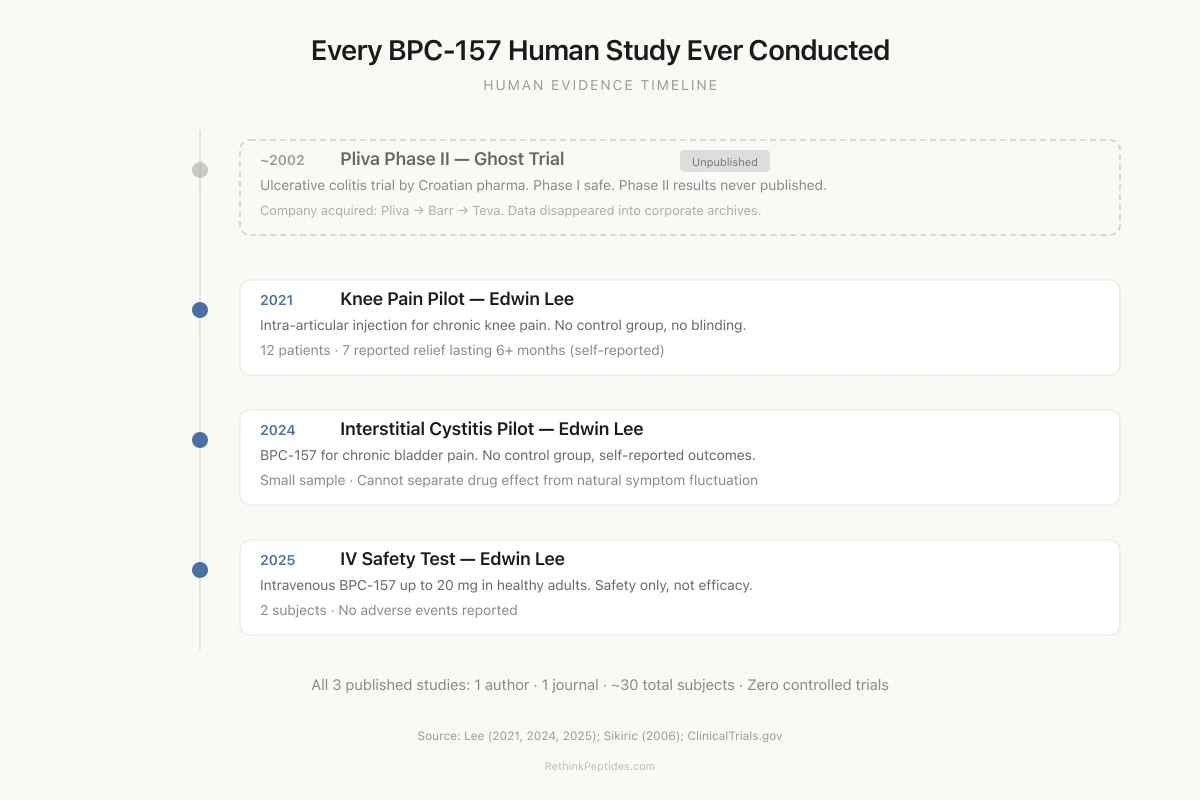
Every BPC-157 Human Study Ever Conducted
Ulcerative colitis trial by Croatian pharma company Pliva. Phase I was safe. Phase II results were never published.
Intra-articular BPC-157 injection for chronic knee pain. No control group, no blinding.
BPC-157 for chronic bladder pain. No control group, self-reported outcomes.
Intravenous BPC-157 up to 20 mg in healthy adults. Safety only, not efficacy.
All 3 published studies are by one author (Edwin Lee) in one journal. None are randomized controlled trials. The one trial that was controlled was never published.
Source: Lee (2021, 2024, 2025); Sikiric (2006); ClinicalTrials.gov
 View as image ↗
Study 1: Knee pain (2021). Edwin Lee published a pilot study of intra-articular BPC-157 injections for chronic knee pain in Alternative Therapies in Health and Medicine.[4] Twelve patients received a single injection. Seven reported pain relief lasting more than six months. There was no control group, no placebo arm, no blinding. The patients knew what they were receiving, and the outcomes were self-reported.
Study 2: Interstitial cystitis (2024). Lee published a second pilot, this time for interstitial cystitis (chronic bladder pain), in the same journal.[5] Interstitial cystitis is a condition with few effective treatments, which makes any positive signal interesting. But the study had a small sample, no control group, and self-reported symptom outcomes. Without a placebo arm, there is no way to separate the effect of BPC-157 from the natural fluctuation of a condition known for symptom waxing and waning.
Study 3: IV safety (2025). Lee's third study tested intravenous BPC-157 infusion in 2 healthy adults at doses up to 20 mg.[3] No adverse events were reported. The study's purpose was safety, not efficacy, and with 2 subjects it can establish only that those 2 specific people tolerated the infusion.
All three studies appear in Alternative Therapies in Health and Medicine, a journal that does not carry the same peer review rigor as major medical journals. All three are by the same author. None have been independently replicated. None are randomized controlled trials.
For context, semaglutide (Ozempic) went through Phase III trials involving thousands of patients across multiple countries before approval. BPC-157 has 30 subjects, one investigator, and no Phase III trial on any horizon. A deeper look at why there is almost no human data is covered separately.
The Single-Lab Problem
Predrag Sikiric is a professor of pharmacology at the University of Zagreb. His lab has produced more than 150 published papers on BPC-157 since 1993. By any measure, the majority of the entire BPC-157 literature comes from this one group.
In science, a finding is not considered established until it has been independently replicated, meaning a different lab with different researchers, different equipment, and no financial connection to the original team gets the same result. For BPC-157, that independent replication is nearly absent.
There are exceptions. Chang and colleagues in Taiwan showed in 2014 that BPC-157 upregulated growth hormone receptor expression in tendon fibroblasts.[9] Xu and colleagues in China conducted a formal preclinical safety evaluation in 2020, testing BPC-157 for acute toxicity, genotoxicity, and hemolysis in rats.[8] They found no acute toxicity at doses up to 10 mg/kg. These independent studies exist. But they are the exception, not the pattern.
There is a further complication. Sikiric is listed as the CEO of a company called Diagen, which holds patents for what it describes as a "special stable version" of BPC-157. This financial interest was not disclosed in his published papers. In standard scientific practice, a researcher with a patent and a company tied to their research subject would be required to declare that conflict. The full scope of this single-lab concentration is worth its own examination.
The Ghost Trial
In the late 1990s and early 2000s, the Croatian pharmaceutical company Pliva sponsored clinical trials for BPC-157 as a treatment for inflammatory bowel disease. The peptide was assigned three drug designations: PL-10, PLD-116, and PL14736.
Sikiric described the program in a 2006 review in Inflammopharmacology.[6] Phase I trials tested rectal administration of BPC-157 in healthy volunteers and found it safe and well-tolerated. A Phase II trial in patients with mild-to-moderate ulcerative colitis was initiated.
Then nothing happened. Or more precisely, nothing was ever made public.
The Phase II results were never published. No journal article, no conference abstract, no press release. A clinical trial registration (NCT02637284) appears on ClinicalTrials.gov with a status listed as unknown since 2016. The trial was supposed to report results. It did not. Pliva was acquired by Barr Pharmaceuticals, which was later acquired by Teva Pharmaceutical Industries. Whether the trial data exists inside Teva's archives, whether the results were negative, or whether the trial simply stopped when the company changed hands is not publicly known.
This is what is known as a ghost trial: a study that was registered, conducted, and then never reported. Ghost trials are a recognized problem in clinical research because negative results that go unpublished distort the evidence base. If BPC-157 failed in the one controlled human trial that was actually conducted, that failure is invisible. For a deeper look at this specific topic, see BPC-157 for inflammatory bowel disease.
What the Animal Studies Actually Show
The preclinical evidence for BPC-157 is not fabricated or trivial. Across more than 100 animal studies, BPC-157 has shown consistent effects in specific domains.
The most-cited musculoskeletal study is Staresinic et al. (2003), which tested BPC-157 on transected rat Achilles tendons.[10] Rats that received BPC-157 showed accelerated tendon healing compared to controls, along with increased tendocyte growth in vitro. This study has been replicated in variations (different tendons, different injury models) primarily within the Zagreb lab.
Gastric protection is where BPC-157 was first identified. Dozens of studies show it protects rat stomach lining against NSAIDs, alcohol, and stress-induced ulcers. The effect is consistent enough that BPC-157's discoverers named it "Body Protection Compound" specifically for this property.
Fistula healing is another area with multiple positive animal studies. BPC-157 has been tested on gastrocutaneous, rectovaginal, colovesical, and esophagocutaneous fistulas in rats, with positive results in each model.
But three things limit what these animal studies can tell us.
First, the route of administration. Most rat studies use intraperitoneal injection (directly into the abdominal cavity). That is not how people use BPC-157. Subcutaneous injection and oral capsules, the two most common human routes, have not been studied with the same rigor in animals.
Second, the doses. Animal doses are calculated per kilogram of body weight and do not scale linearly to humans. The "effective dose" in a 250-gram rat does not translate directly to a dose for an 80-kilogram human.
Third, the translation rate. Drug development has a well-documented failure rate: roughly 90% of compounds that show promise in animal models fail in human trials. This is not a BPC-157-specific problem. It is a fundamental limitation of preclinical research. BPC-157 for tendon injuries covers the musculoskeletal animal data in detail.
- Cell & Lab Studiescompleted
Mechanism work showing VEGF pathway activation, nitric oxide modulation, growth hormone receptor upregulation
- Animal Studiescompleted
100+ studies in rats across gut, tendon, bone, fistula, and nerve models — consistently positive
- Uncontrolled Pilot Studiescurrent
3 studies, ~30 subjects, 1 investigator, no control groups, no blinding
- Randomized Controlled Trialmissing
None has ever been conducted for any indication
- Phase III Trialmissing
No major pharmaceutical company is pursuing BPC-157 trials
- Regulatory Approvalmissing
Not approved in any country for any indication
BPC-157 has unusually strong preclinical data for a peptide. But it's stuck at the bottom of the human evidence pyramid. The jump from animal studies to uncontrolled pilots is the only progress made in 30 years of research.
Vasireddi et al. (2025); McGuire et al. (2025); aggregate BPC-157 literature
The Regulatory and Legal Reality
In 2023, the FDA classified BPC-157 as a Category 2 bulk drug substance. Category 2 means the FDA has determined that the substance "may present significant safety risks" when used in compounding. Licensed pharmacies cannot legally compound BPC-157 for human use.
The FDA cited three concerns: potential immunogenicity (the peptide could trigger immune reactions), manufacturing impurity risks (synthetic peptides can contain truncated sequences and other contaminants), and a lack of human safety data sufficient to evaluate risk.
BPC-157 also appears on WADA's prohibited list. Athletes who test positive for BPC-157 face sanctions. The anti-doping agency USADA has issued specific warnings about BPC-157, calling it an "experimental peptide" with insufficient safety data.
No regulatory agency anywhere in the world has approved BPC-157 for any indication.
Safety
CriticalFDA Category 2: cannot be legally compounded
Concern
The FDA classified BPC-157 as Category 2 in 2023, meaning licensed pharmacies cannot legally compound it. The FDA cited potential immune reactions, manufacturing impurity risks, and insufficient human safety data. No regulatory agency anywhere has approved BPC-157.
What the research says
The only formal safety study (Xu et al., 2020) found no acute toxicity in rats at doses up to 10 mg/kg. Two healthy humans tolerated IV infusion up to 20 mg. That is the full extent of published safety data.
Particularly relevant for: Anyone considering purchasing or using BPC-157
What to do
Products sold as 'research peptides' are not regulated for purity, sterility, or actual contents. WADA has banned BPC-157 for athletes. Discuss with a healthcare provider before considering use.
FDA Category 2 classification (2023); Xu et al. (2020); Lee (2025)
The peptide remains available through "research peptide" suppliers who sell it labeled as "not for human consumption." This legal gray area allows it to be purchased without a prescription, compounding the safety concern: the purity, sterility, and actual contents of these products are not guaranteed by any regulatory body. For a full breakdown of the regulatory landscape, see BPC-157 and the FDA's Category 2 classification.
Where This Leaves the Evidence
BPC-157 is not a scam. The animal data is real, extensive, and consistently positive across multiple injury and disease models. Something is happening in those rat studies. The peptide has biological activity.
But the human evidence is thinner than for almost any substance with this level of internet popularity. Three pilot studies. One investigator. Roughly 30 subjects. No randomized controlled trial. No Phase III data. No published results from the one Phase II trial that was actually conducted.
Evidence Comparison
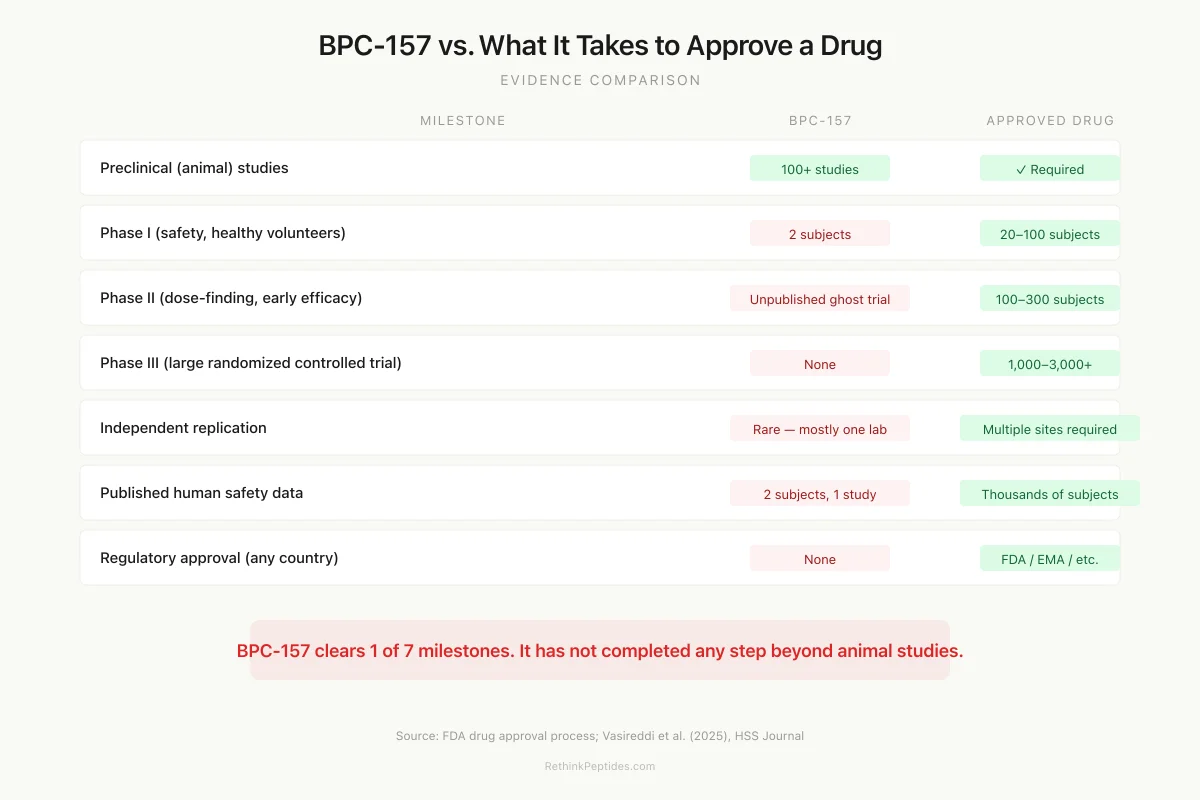
BPC-157 vs. What It Takes to Approve a Drug
BPC-157 clears only the first hurdle — animal studies. It has not completed any of the 6 remaining steps required to prove a drug works in humans.
Source: FDA drug approval process; Vasireddi et al. (2025)
 View as image ↗
The gap between what people believe about BPC-157 and what has been demonstrated in humans is one of the largest in peptide research. That gap is not closing. No major pharmaceutical company is running BPC-157 trials. The FDA's Category 2 classification makes clinical development in the United States more difficult, not less. And the single-lab concentration of the existing evidence means that what we have is not what scientists would call a robust, independently verified evidence base.
None of this means BPC-157 will never work in humans. It means we do not yet know whether it does. And the infrastructure that would normally answer that question, large pharmaceutical trials with thousands of patients and independent oversight, does not exist for this compound and shows no signs of materializing.
The internet has made its decision about BPC-157. The science has not.
Research Gaps
What would it take?
What would it take to know if BPC-157 actually works in humans?
Independent replication of key animal findings
A few labs outside Zagreb have confirmed some effects, but the vast majority of studies come from one group
Phase I dose-finding trial with pharmacokinetics
We don't know BPC-157's half-life, bioavailability, or dose-response curve in humans
Randomized, placebo-controlled trial for any indication
No RCT has ever been conducted — the closest was the unpublished Pliva Phase II
GMP-grade pharmaceutical formulation
FDA Category 2 classification makes US-based development difficult
Published results from the Pliva Phase II ghost trial
Trial data likely exists in Teva's archives but has never been made public
Assessment based on ClinicalTrials.gov, FDA guidance, and published literature
The Bottom Line
BPC-157 has real preclinical data across dozens of animal models showing consistent healing effects. What it does not have is meaningful human evidence. Three pilot studies, one investigator, roughly 30 subjects, and no randomized controlled trial. The gap between the internet narrative and the published science is one of the largest in peptide research.
Frequently Asked Questions
Sources & References
- 1RPEP-13892·Vasireddi, Nikhil et al. (2025). “BPC-157 for Sports Injuries: What a Systematic Review of the Evidence Actually Shows.” HSS journal : the musculoskeletal journal of Hospital for Special Surgery.Study breakdown →PubMed →↩
- 2RPEP-12503·McGuire, Flynn P et al. (2025). “BPC-157 for Muscle and Tendon Healing: What Science Actually Shows vs. What Athletes Believe.” Current reviews in musculoskeletal medicine.Study breakdown →PubMed →↩
- 3RPEP-12011·Lee, Edwin et al. (2025). “First Study of Intravenous BPC-157 in Humans Shows No Side Effects in Two Patients.” Alternative therapies in health and medicine.Study breakdown →PubMed →↩
- 4RPEP-05534·Lee, Edwin et al. (2021). “BPC-157 Knee Injections Relieved Pain in 88% of Patients Across Multiple Knee Conditions.” Alternative therapies in health and medicine.Study breakdown →PubMed →↩
- 5RPEP-08643·Lee, Edwin et al. (2024). “BPC-157 Injection Resolved Bladder Pain Symptoms in 10 of 12 Women: A Pilot Study.” Alternative therapies in health and medicine.Study breakdown →PubMed →↩
- 6RPEP-01187·Sikiric, P et al. (2006). “BPC-157 in Clinical Trials for IBD: Comprehensive Animal Evidence Supporting Human Testing.” Inflammopharmacology.Study breakdown →PubMed →↩
- 7RPEP-03909·Sikiric, Predrag et al. (2018). “BPC 157: How a Stomach Peptide May Heal Injuries Across the Body by Controlling Blood Vessel Function.” Current pharmaceutical design.Study breakdown →PubMed →↩
- 8RPEP-05208·Xu, Chuanyang et al. (2020). “Preclinical safety evaluation of body protective compound-157, a potential drug for treating various wounds..” Regulatory toxicology and pharmacology : RTP.Study breakdown →PubMed →↩
- 9RPEP-02350·Chang, Chung-Hsun et al. (2014). “Pentadecapeptide BPC 157 enhances the growth hormone receptor expression in tendon fibroblasts..” Molecules (Basel.Study breakdown →PubMed →↩
- 10RPEP-00860·Staresinic, M et al. (2003). “BPC-157 Accelerates Achilles Tendon Healing and Directly Stimulates Tendon Cell Growth.” Journal of orthopaedic research : official publication of the Orthopaedic Research Society.Study breakdown →PubMed →↩